Financial Literacy in Real Estate
It feels great earning a six-figure salary or closing that deal which has many zeros at the end. Thereafter, what one does with their money remains an open thought. An entrepreneur who interviewed 21 billionaires says there’s a common misconception about how the world’s richest people spend their money. He wrote that contrary to people’s perceptions, these billionaires viewed money as something to invest rather than spend. “People think billionaires sleep on tons of money devising new ways of spending it. However, nothing could be further from the truth. Almost all billionaires’ wealth lies in the companies they own, in stocks, real estate and other assets”, he wrote.
Each person contemplates making an investment of one kind or the other. Whereas this seems the obvious thing to do, investing is not always easy. With it may come serious repercussions having impact on one’s health, social well-being or relationships. As not all investments will be profitable, it’s extremely important to have the right information and skills before investing. Am sure most of us have had a horror investment experience. Personally, I’d considered myself relatively astute when it came to matters investment. So, when a friend approached me with a real estate-backed investment, I got interested. I visited the company’s websites later their offices and a few days after, I’d signed up. I went ahead to invest millions then sat to await my guaranteed returns of 18% p.a. Hardly one year down, the company had applied to go into voluntary administration. Alas! it was all a bull trap. This same allure of high returns had visited lawyers, doctors & other professionals. In hindsight, the investment decision was wrong. Did we have sufficient financial literacy of the product? Had we carried out proper due diligence on the company or its directors? But how about the Corporate Guarantee the company issued?
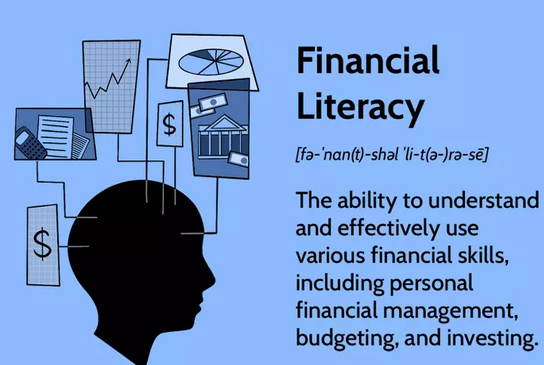
As such, the entry to conversation of financial literacy lies a measure of how one understands key financial concepts plus the skills and abilities of allocating limited resources to competing interests. Unfortunately, most people yearn to earn more and more money but have limited knowledge of how it works. When you are financially literate, you create a relationship with money and a lifelong journey of inner peace and joy.
Households with higher levels of financial literacy are more likely to plan for investments and arrive at retirement with substantially more assets than non-planners. Truth is when it comes to investing, ones underlying perception of risk; emotional inclinations; financial literacy and psychological biases, color how we perceive the world. Even finance professors with presumably high financial literacy, do not implement their theoretical knowledge when building their own portfolio. While achieving a profit induces pride, closing at a loss induces regret – regret being stronger than pride. As a result, investors may be prone to inaction rather than action due to the strong fear of regret. At Konza Spaces, we are all about encouraging investors to timely own well-researched land opportunities.

REAL ESTATE
Real estate investments have traditionally been a terrific inflation hedge. In addition to behavioral factors, price and location of the property are considered important factors. Further, capital gains and market information have high impact on property investment decisions. Again, we at Konza Spaces, take delight in bringing as much market information as possible.
The perimeters of Nairobi are expanding to bursting point due to demand for real estate. Satellite towns have increasingly become a hit for investors contemplating real estate investment, specifically raw land. Besides the 5 common considerations in land investment- price, location, timing, risk and deal – what financial considerations should one take into account?
- Debt to Income Ratio – Your debt-to-income (DTI) ratio is how much money you earn versus what you spend. It’s calculated by dividing your monthly debts by your gross monthly income. Generally, if you are considering a taking out a loan or better affording your investment, it’s a good idea to keep your DTI ratio below 43%, though 35% or lower is a good metric.
- Portfolio Diversification – The elements of portfolio diversification are risk-free, low-risk, medium, and high-risk. Land is generally considered low risk. The simplicity and stability that comes with owning the right piece of land, purchased at the right price, can far outweigh a myriad of problems that come with many other types of investment.
- Lead Time Between Asset Conversion to Cash – Land investment involves changing liquid cash into a fixed asset. Its normally not expected to be sold within a year. Its therefore pragmatic to understand that you are locking up funds that may take time to convert back into cash. Ensure you have an adequate budget during such lead times to avoid re-selling your land at a discount.
- Land Tenure Classifications in Kenya – Land in Kenya is classified as private, public or community. Private land can be on freehold or leasehold. Stamp duty for freehold, land mainly in rural areas, is 2% while for leasehold, land mainly in municipalities and towns, is 4%.
- Ownership Details – It’s not uncommon to see chamas and other collective investment schemes investing into real estate on behalf of members. The investor is then allocated a share certificate with title to property being vested in separate entities. Establish the terms and conditions of such agreements. What rights and recourse remain with you as an investor? Some directors are duping their investors through well layered sophisticated schemes – Don’t be a victim statistic.
